
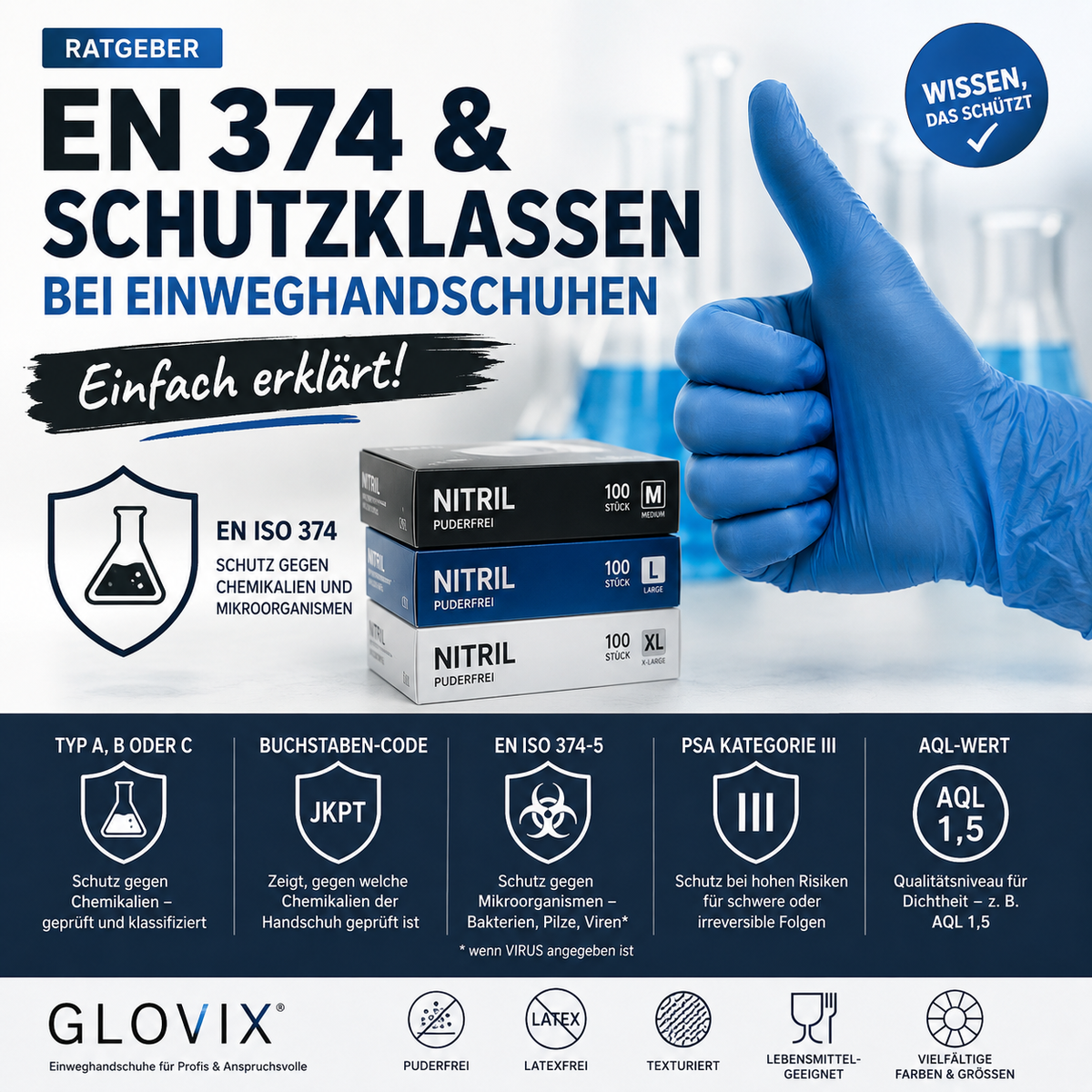
EN 374 & protection classes for disposable gloves explained simply
Disposable gloves are not all the same. Especially in professional applications, not only the material is crucial, but also the question of against which risks a glove has actually been tested.
One of the most important standards for chemical protective gloves is EN ISO 374. It helps to select suitable gloves for handling chemicals and microorganisms.
What does EN ISO 374 mean?
EN ISO 374 describes requirements for protective gloves against hazardous chemicals and microorganisms.
Disposable nitrile gloves often feature markings such as:
EN ISO 374-1 Type A, Type B or Type C
This classification indicates, among other things, against how many defined test chemicals a glove achieves a certain minimum breakthrough time.
What do Type A, Type B and Type C mean?
Type A
A glove of EN ISO 374-1 Type A must achieve a permeation performance of at least Level 2 for at least six test chemicals.
Type A therefore stands for particularly comprehensive tested chemical protection.
Type B
For Type B, the glove must achieve at least permeation Level 2 for at least three test chemicals.
Such gloves may be suitable for professional applications where defined chemical protection is required.
Type C
For Type C, at least one test chemical must achieve permeation Level 1.
Many high-quality disposable nitrile gloves are also classified as Type C. Therefore, it is always crucial to consider which specific chemical was tested and for what purpose the glove is intended to be used.
What do the letters under the chemical symbol mean?
For Type A and Type B gloves, letters such as J, K, P or T may be indicated under the corresponding pictogram.
Each letter stands for a specific test chemical. The letter combination therefore shows more precisely against which chemicals the glove has been tested.
One example is the marking:
EN ISO 374-1 Type B – JKPT
The marking does not mean that the glove protects against every conceivable chemical. Therefore, the data sheet of the respective manufacturer should always be considered before use.
What does EN ISO 374-5 mean?
EN ISO 374-5 concerns protection against microorganisms.
Depending on the test, a glove may offer protection against bacteria and fungi or additionally against viruses.
If “VIRUS” is expressly indicated under the corresponding symbol, the glove has also been tested for virus penetration in accordance with the requirements of the standard.
What does PPE Category III mean?
Many professional chemical protective gloves belong to PPE Category III.
This category concerns personal protective equipment for protection against risks that may have serious or irreversible health consequences.
However, the marking should always be considered together with the specific standards and manufacturer information.
What role does the AQL value play?
Disposable gloves often also feature an AQL value, for example AQL 1.5.
AQL stands for Acceptable Quality Level and is used, among other things, in leak testing. Simply put, the value describes the statistical quality requirement within a tested production batch.
The AQL value is therefore an important quality characteristic – however, it does not replace the assessment of the protection class and the respective standards.
Nitrile, latex or vinyl – the material alone is not enough
The material of a disposable glove is also important. Nitrile, for example, is often used because it is flexible, resistant and latex-free.
Nevertheless, a glove should not be selected solely on the basis of the material or its material thickness.
For professional applications, the following are particularly relevant:
- intended area of application
- applicable standards
- chemical protection
- material thickness and length
- AQL
- fit and size
- food contact, if required
- manufacturer information and technical data sheet
Which disposable glove is the right one?
The right choice always depends on the specific application. A glove for food processing must meet different requirements than a glove for cleaning, laboratory, workshop or handling certain chemicals.
Therefore, Glovix presents technical information such as material, thickness, length, AQL, protection class and relevant standards as clearly as possible for its products.
This makes it easier for both professional users and private consumers to select the right disposable glove for their application.
Conclusion: Compare protection classes before purchase
EN ISO 374, PPE category and AQL are much more than technical specifications on packaging. They help to assess what tested protection a disposable glove actually offers.
Anyone who needs gloves for professional or demanding applications should therefore not decide solely on color or price, but consider the technical properties and the manufacturer's data sheet.