
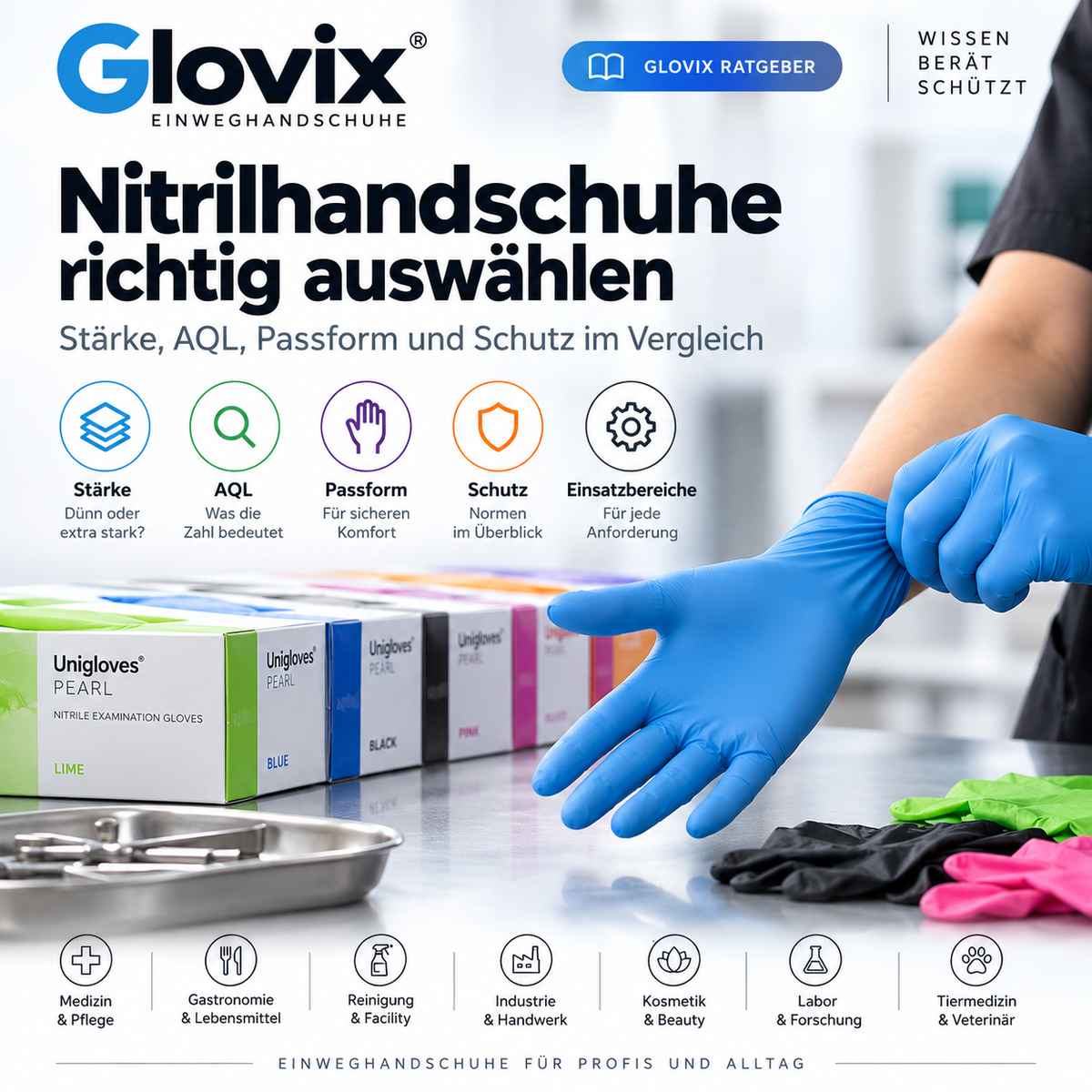
Choosing the Right Nitrile Gloves: Comparing Thickness, AQL, Fit, and Protection
Nitrile gloves are now among the most commonly used disposable gloves. They are used in medicine and healthcare as well as in catering, food processing, cleaning, cosmetics, tattoo parlours, laboratories, workshops, and many other areas.
But not all nitrile gloves are the same. Differences exist in material thickness, fit, surface texture, protection class, AQL value, and chemical resistance. Color can also play an important role in organizing different work and hygiene areas.
If you want to choose the right glove, you should therefore not only consider price or color. In this guide, we show you which properties really matter.
Why are nitrile gloves so popular?
Nitrile is a synthetic plastic that is particularly well suited for making thin and flexible disposable gloves. Modern nitrile gloves offer good tactile sensitivity and can at the same time form a reliable barrier between hands and the work environment.
Another advantage is the wide selection. Nitrile gloves are available today in very thin versions for tasks requiring high dexterity, as well as significantly thicker versions for more demanding activities.
In addition, there are different sizes, surfaces, and colors. This makes it possible to adapt the glove much more precisely to the respective area of application.
Material thickness: Thin is not automatically worse
One of the most important distinguishing features is material thickness.
Thinner nitrile gloves normally offer particularly good tactile sensitivity and high finger mobility. This can be an advantage, for example, in precise tasks in medicine, cosmetics, laboratories, or catering.
Thicker nitrile gloves, on the other hand, are interesting when robustness and mechanical resistance are more important.
Therefore, it is important to remember:
The thickest glove is not automatically the best glove.
What matters is which properties are required for the respective task. For precise work, a thin, well-fitting glove may be the better choice. For heavier use, a more robust version may be more appropriate.
That is why at Glovix you will find both classic nitrile gloves and extra-thick nitrile gloves for more demanding applications.
What does AQL mean for nitrile gloves?
The specification AQL can be found on many packages. The abbreviation stands for “Acceptable Quality Level” and plays an important role in the quality testing of disposable gloves.
Simply put, the AQL value describes a statistical quality level within a tested production batch. For examination gloves, for example, you will often encounter an AQL of 1.5.
It is important to note: An AQL value does not mean that a certain defect rate is accepted for every individual glove. It is a statistical testing procedure for production batches.
Therefore, AQL should always be considered together with the other product properties and the stated standards.
EN 374: Protection against chemicals and microorganisms
Anyone buying nitrile gloves for professional activities will often encounter the EN ISO 374 standard.
It concerns protective gloves against hazardous chemicals and microorganisms. Depending on the tested chemical resistance, gloves may be marked as Type A, Type B, or Type C.
However, you should not simply assume that every nitrile glove is automatically suitable for every chemical. The actual resistance depends on the respective product and the tested chemical.
Anyone who regularly works with certain chemicals should therefore always consult the data sheet of the respective glove and the test values stated there.
We explained the protection classes and markings in even greater detail in our Glovix guide “EN 374 & Protection Classes for Disposable Gloves Explained Simply”.
Fit: The right size is crucial
A high-quality glove is of little use if it does not fit properly.
If a nitrile glove is too small, the material is constantly under tension. This can be uncomfortable and restrict freedom of movement.
If it is significantly too large, it can slip and make precise work difficult.
A well-fitting nitrile glove should fit the hand without pressing uncomfortably. The fingers should be able to move freely, and the glove should remain as comfortable as possible even during prolonged use.
That is why many of our nitrile gloves are available in several sizes from XS to XL, and sometimes beyond.
Textured fingertips provide a better grip
Another important feature is the surface of the glove.
Many high-quality nitrile gloves have textured or roughened fingertips. This can improve grip on small objects, tools, or work materials.
This is particularly useful for tasks that require precision.
These include, for example:
- medical and healthcare activities
- laboratory work
- tattooing and piercing
- cosmetics and beauty
- catering and food processing
- cleaning
- assembly and workshop work
Depending on the area of application, fully textured gloves may also be appropriate.
Powder-free, latex-free, and thiuram-free – what does that mean?
When choosing products, you will often find specifications such as powder-free, latex-free, or thiuram-free.
Powder-free gloves do not use the powdering that was once commonly used. This is now widespread with high-quality nitrile gloves.
Nitrile itself is not natural rubber latex. That is why many nitrile gloves are an interesting alternative to classic latex gloves. However, if you have an existing allergy, you should always follow the specific manufacturer’s information for the respective product.
The specification thiuram-free can also be found on various gloves. Thiurames can cause contact allergies in sensitive individuals. Anyone who may react to them should therefore pay close attention to the manufacturer’s information.
Food-safe: Not every glove is automatically suitable for food
Nitrile gloves are very commonly used in catering, kitchens, and food production.
However, the material nitrile alone is not the deciding factor. A glove must be expressly intended by the manufacturer for the relevant contact with food or tested for it.
That is why at Glovix we indicate whether products are certified as food-safe.
Especially in food processing, different glove colors can also be helpful for visually separating work areas or processes.
What role does color play?
Nitrile gloves no longer have to be only blue or black.
Today they are available in numerous colors such as Black, Blue, Cobalt, Green, Lime, Pink, Magenta, Burgundy, Orange, Yellow, Violet, or White.
On the one hand, colors can match the appearance of a company. On the other hand, they can help visually distinguish different activities, groups of employees, or hygiene areas.
That is precisely why, for example, the Unigloves Pearl Series offers an exceptionally wide range of colors.
We explain in detail which color is particularly well suited for which application in our guide “Nitrile Gloves: Which Color Is Best for Which Application?”
When are extra-thick nitrile gloves appropriate?
Not every activity requires a particularly thick glove.
However, anyone who works with tools, frequently cleans surfaces, or puts greater mechanical stress on the glove can benefit from a more robust version.
Extra-thick nitrile gloves are therefore used, among other applications, for cleaning, industry, workshops, assembly, and various technical applications.
But the same rule applies here: material thickness alone does not tell you everything about the full protection offered by a glove.
For chemicals or special hazards, the standards and manufacturer’s specifications for the specific product must always be considered.
Disposable gloves are not universal protective gloves
One important point is often overlooked when buying: disposable gloves are not automatically suitable for every job.
Even a high-quality nitrile glove has its limits.
Special protective gloves may be required for aggressive chemicals, high temperatures, sharp-edged objects, or special mechanical hazards.
Therefore, the selection should always be based on the actual area of application.
How to find the right nitrile glove
Before buying, it is worth answering a few questions:
- For which activity do I need the glove?
- Do I need particularly good tactile sensitivity or greater robustness?
- Which size fits my hand?
- Do I need textured fingertips or a stronger overall texture?
- Will the glove come into contact with food?
- Will there be contact with chemicals or microorganisms?
- Which standards and protection classes are required?
- Does color matter for my work area?
Anyone who considers these points can make a much more targeted selection than by considering only price or appearance.
Conclusion: The right nitrile glove depends on the application
There is no single perfect nitrile glove for every application.
For some activities, thin, flexible gloves with excellent tactile sensitivity are ideal. In other areas, robustness, chemical protection, or a particularly grippy surface is more important.
Material thickness, AQL, fit, surface texture, standards, and area of application should therefore all be considered together.
At Glovix you will find a wide selection of nitrile gloves in different thicknesses, sizes, colors, and versions – from classic examination gloves and the colorful Pearl Series to extra-thick models for more demanding applications.
This way you can choose exactly the glove that is right for your work.